The evidence for 2–3 strength sessions per week holds across almost every population. But how you train, what you prioritise, and what success looks like shifts significantly depending on your age and stage.
Here’s what we see working — and what we see going wrong — across four groups we work with regularly at Summit.
The 70 Year Old
The goal at 70 is non-negotiable: maintain the ability to move independently, reduce fall risk, and stay out of a surgeon’s waiting room.
Strength training is the most powerful tool available for all three. The research on resistance training in older adults is unambiguous — it preserves muscle mass, improves bone density, and maintains the neuromuscular coordination that keeps you upright when you trip on a step.
The mistake we see most often at this age is avoidance. People arrive having spent years steering clear of anything that might hurt a shoulder, a hip, a back — and in doing so they’ve lost the very capacity that would protect those joints.
Soreness after strength training at 70 is normal. It’s not damage. The body adapts more slowly, so recovery takes longer — but the adaptation still happens.
What 70 year olds often underestimate is how much mobility work needs to happen alongside strength training. Two sessions a week in the gym won’t undo the hours spent sitting if there’s nothing else filling the gap. Walking, gentle movement, hip mobility, shoulder mobility — this is the other half of the prescription that most people skip.
The priority: Keep moving. Load the body appropriately. Don’t confuse caution with safety.
The 60 Year Old
At 60 the same principles apply, but there’s more capacity to work with and more to lose if training stalls.
This is the decade where muscle loss accelerates if nothing is done about it. Sarcopenia — age-related muscle loss — doesn’t wait until 70. It’s already underway, and the gap between people who strength train through their 60s and those who don’t becomes obvious by the time they hit 70.
The pattern we see at this age mirrors what we see at 70 — a real wariness around pain and injury that leads to underloading. People back off at the first sign of discomfort, assume something is wrong, and train at an intensity that maintains nothing.
There’s also the mobility gap. Most 60 year olds have spent decades accumulating movement restrictions — hips that don’t open, thoracic spines that don’t rotate, shoulders that don’t reach overhead without compensating somewhere else. Strength training without addressing those restrictions just reinforces them.
The good news is that the 60 year old body responds well to appropriate load. You don’t need to train like a 30 year old. You do need to train consistently and progressively.
The priority: Progressive load, consistent frequency, and mobility work that happens outside the gym — not instead of it.
The 50 Year Old
This is the group that most often wants to feel worked.
There’s nothing wrong with that instinct — training hard is a good thing. The problem is when “feeling worked” becomes the measure of a good session rather than actual progress.
At 50, recovery takes longer than it did at 30. The session that felt fine on Monday can catch up with you by Wednesday. High intensity every session stops being a strategy and starts being a reason for chronic soreness, disrupted sleep, and a body that never quite feels right.
What works at 50 is intentional variation — sessions that push hard, sessions that don’t, and enough recovery between them to actually adapt. Two to three strength sessions per week with appropriate intensity beats five sessions of grind.
The 50 year old who trains well looks and performs significantly better than one who doesn’t. The gap is real and it’s widening every year. This decade is where the investment either compounds or starts costing you.
The priority: Train hard enough to drive adaptation. Not so hard that recovery becomes the limiting factor.
The High School Athlete
The conversation we have most often with young athletes — and their parents — is about load progression.
The assumption is that heavier is better. That if a 16 year old is serious about their sport, they should be maxing out, lifting what the older athletes lift, and measuring progress in kilograms on the bar.
That’s not how it works — and pushing that approach too early builds movement faults that show up as injuries later.
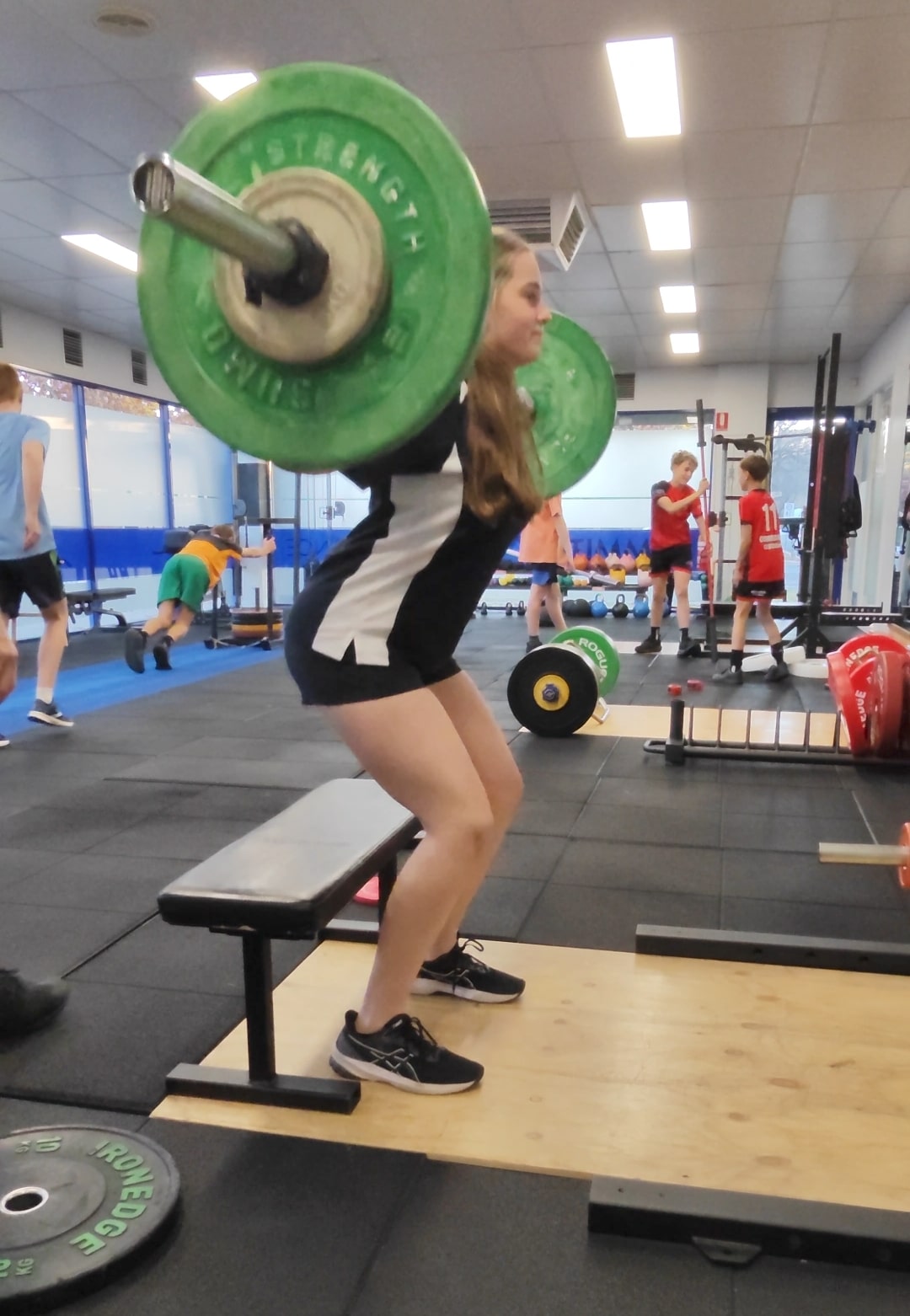
The high school athlete needs to build movement quality first. Hinge, squat, push, pull, carry — done well, with appropriate load, building over time. The strength gains from getting technique right and progressively loading good patterns are significant. They don’t require ego lifting to achieve.
What strength training actually does for a young athlete — when done properly — is reduce injury risk, improve power output, and build the physical resilience to handle increasing sport-specific training loads. A swimmer gets faster. A footballer absorbs contact better. A runner handles more kilometres.
That’s the real return on investment. Not a number on a bar.
The priority: Movement quality before load. Progressive overload over time. Strength in service of sport performance.
What Stays the Same Across All Four
The frequency recommendation doesn’t change much — 2 to 3 sessions per week remains the evidence-based sweet spot regardless of age.
What changes is load, recovery, and what you’re prioritising in each session. A 70 year old and a 16 year old are both doing strength training. They’re just doing different versions of it, for different reasons, with different margins for error.
That’s exactly why cookie-cutter programs don’t work. And it’s why having a coach who understands the difference matters.